The short answer
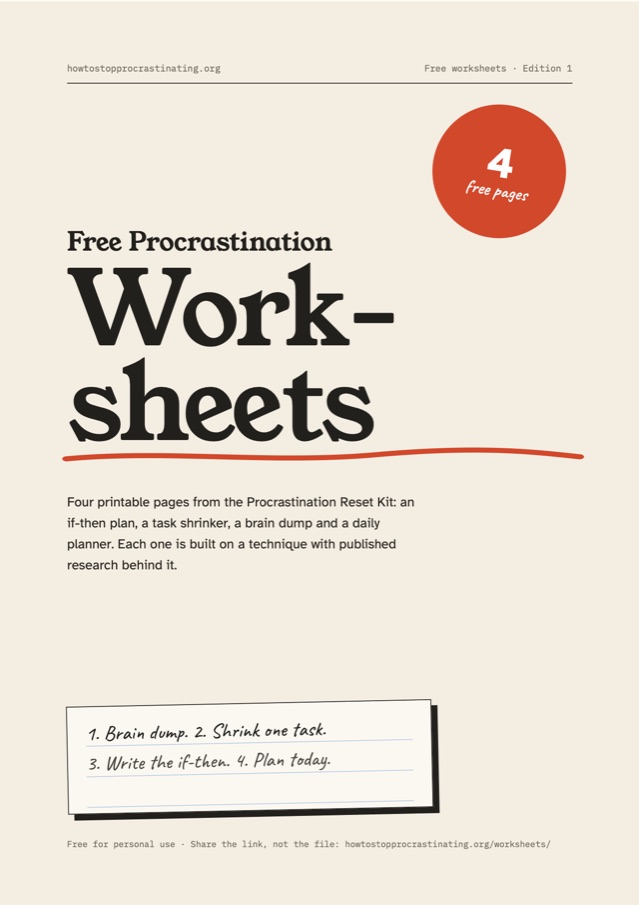
The most useful procrastination worksheets do one of two jobs: they shrink a task until starting feels trivial, or they decide in advance exactly when and where you will start. Those two moves, task breakdown and if-then planning, have the strongest evidence behind them. A brain dump and a simple daily planner keep them going day to day.
What's on each worksheet
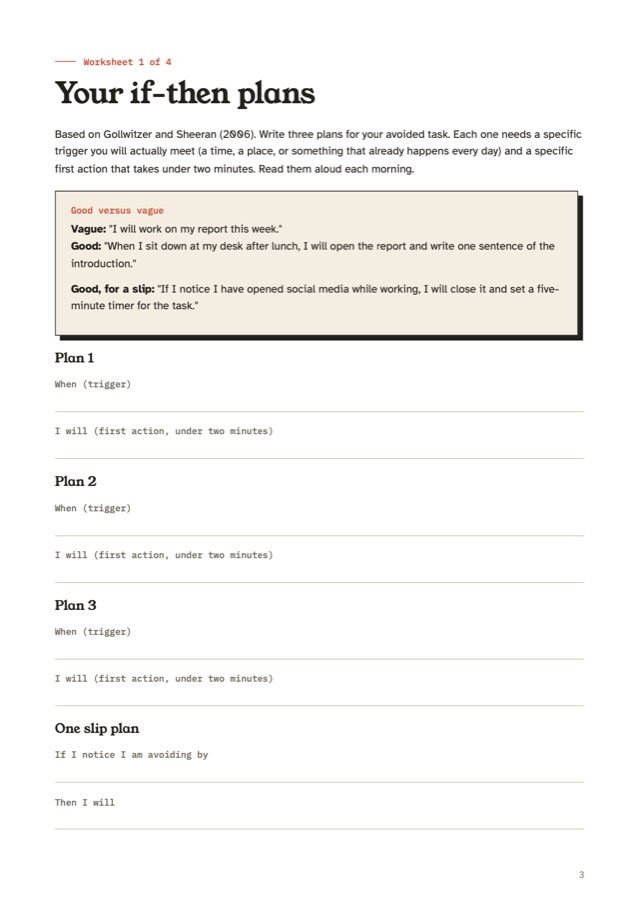
You write three plans in the form "When [situation], I will [first action]", plus one plan for when you slip. This is an implementation intention. Gollwitzer and Sheeran's meta-analysis of 94 studies found a medium-to-large effect on reaching goals, and it is one of the few techniques tested specifically on procrastination. The worksheet shows a vague plan next to a good one, because the trigger has to be something you will actually meet, like a time, a place or something you already do every day.
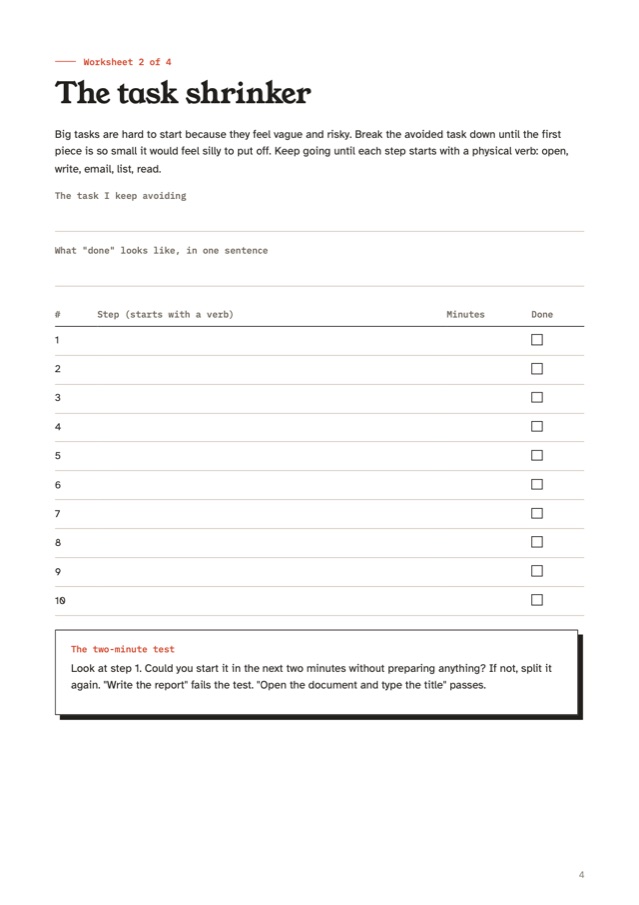
Write the task you keep avoiding and what "done" looks like, then break it into up to ten steps that each start with a physical verb: open, write, email, list. Keep splitting until step 1 passes the two-minute test. Vague, large tasks feel unpleasant, and how unpleasant a task feels is one of the most reliable predictors of putting it off (Steel, 2007). Shrinking it changes how it feels to start.
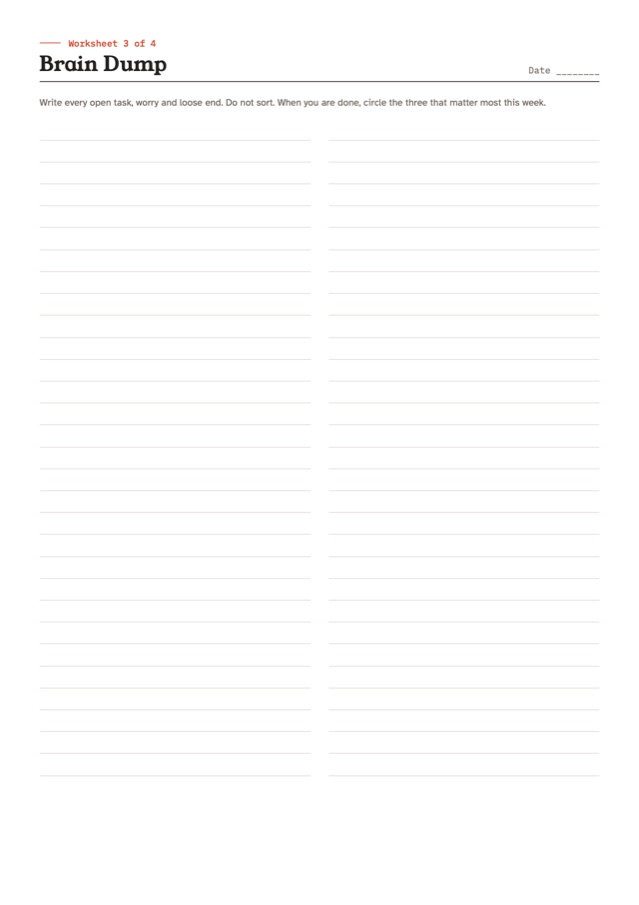
Two columns of lines for every open task, worry and loose end. Don't sort, just write, then circle the three that matter this week. Unfinished tasks keep pulling at your attention, and Masicampo and Baumeister found that simply making a plan for them reduced that pull. It's the fastest way to see what you're actually avoiding.
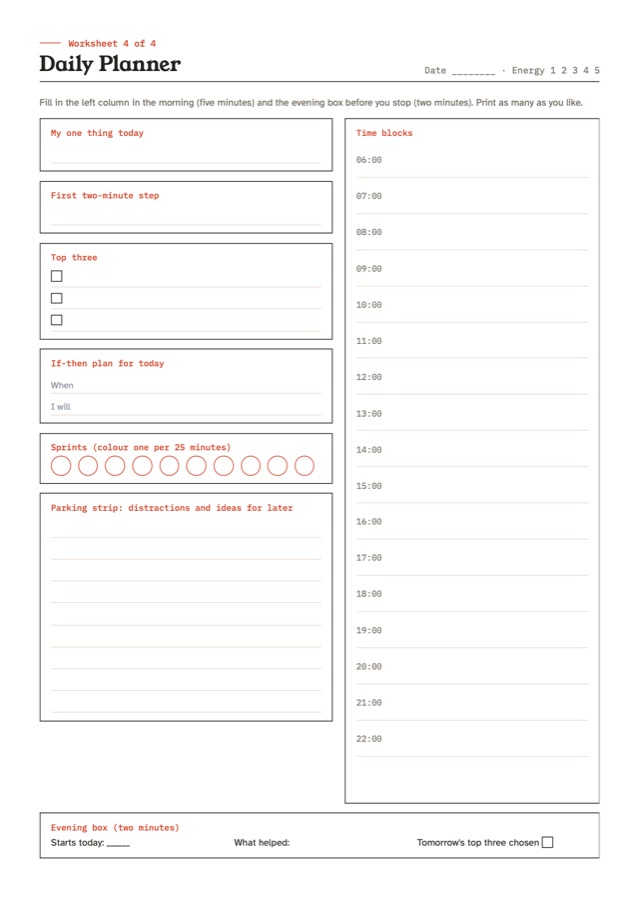
One thing for today, its two-minute first step, a top three, today's if-then plan, ten circles to colour in for each 25-minute sprint, a parking strip for distractions, a time-block column from 6am to 10pm, and a two-minute evening box. It counts starts rather than hours, because starting is the part procrastination blocks.
How to use them
- Brain dump first. Five minutes. Circle the task you are avoiding most.
- Shrink that one task. Five minutes. Stop when step 1 takes under two minutes.
- Write the if-then plan for step 1. Two minutes. Read it aloud.
- Print a daily planner each morning. Five minutes to fill in, two minutes in the evening.
That's about twenty minutes once, then seven minutes a day. If you miss a day, start again with tomorrow's planner rather than catching up. People who forgive themselves for a slip procrastinate less on the next task (Wohl, Pychyl & Bennett, 2010).
Questions
Are these procrastination worksheets really free?
Yes. Enter your email and the PDF downloads straight away. You also get one practical email a week about procrastination, and you can unsubscribe from any email.
What size are the worksheets?
A4, and they print fine on US Letter. They are designed to use little ink, so a normal home printer is fine.
Can I fill them in on a tablet?
Yes. Open the PDF in a note-taking app such as GoodNotes, Notability or the Files app and write on it with a stylus. Printing works better for most people, because paper on your desk is harder to ignore.
Which worksheet should I start with?
The brain dump. It takes five minutes and shows you which task you are actually avoiding. Then shrink that task and write an if-then plan for the first step.
Do worksheets actually help with procrastination?
The techniques on them do. If-then planning has a medium-to-large effect on goal achievement across 94 studies, and breaking a task down reduces how unpleasant it feels to start, which is one of the strongest predictors of delay. A worksheet is just a way to make sure you actually do the technique.
What is the difference between these and the Reset Kit?
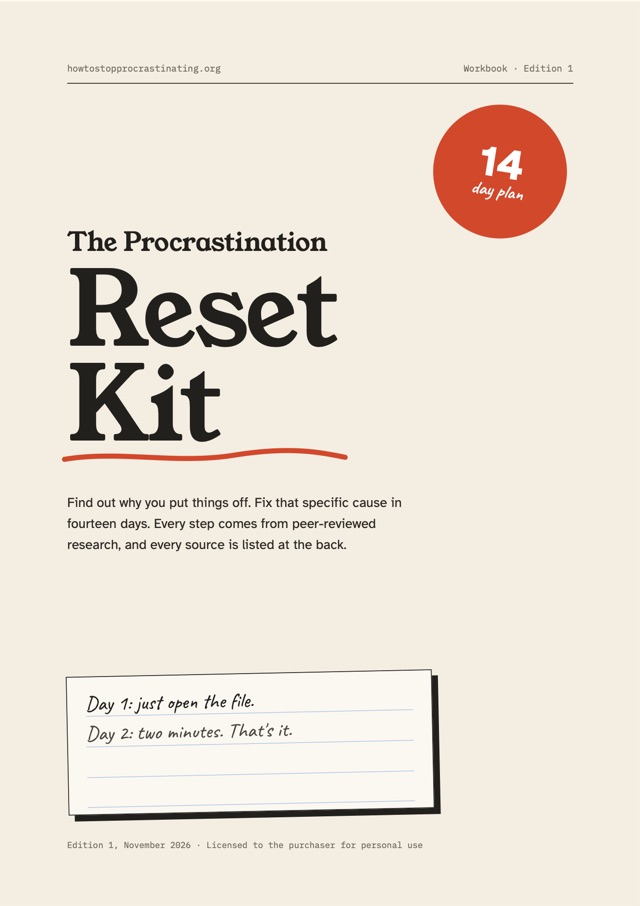
These four pages help you start a task. The Reset Kit also tells you why you stall, with a five-minute diagnostic and a playbook for each of the five causes, plus a 14-day plan and 20 printable pages.
The research behind the worksheets
Gollwitzer, P. M., & Sheeran, P. (2006). Implementation intentions and goal achievement: A meta-analysis of effects and processes. Advances in Experimental Social Psychology, 38, 69–119. https://doi.org/10.1016/S0065-2601(06)38002-1
Steel, P. (2007). The nature of procrastination: A meta-analytic and theoretical review of quintessential self-regulatory failure. Psychological Bulletin, 133(1), 65–94. https://doi.org/10.1037/0033-2909.133.1.65
Masicampo, E. J., & Baumeister, R. F. (2011). Consider it done! Plan making can eliminate the cognitive effects of unfulfilled goals. Journal of Personality and Social Psychology, 101(4), 667–683. https://doi.org/10.1037/a0024192
Wohl, M. J. A., Pychyl, T. A., & Bennett, S. H. (2010). I forgive myself, now I can study: How self-forgiveness for procrastinating can reduce future procrastination. Personality and Individual Differences, 48(7), 803–808. https://doi.org/10.1016/j.paid.2010.01.029