The short answer
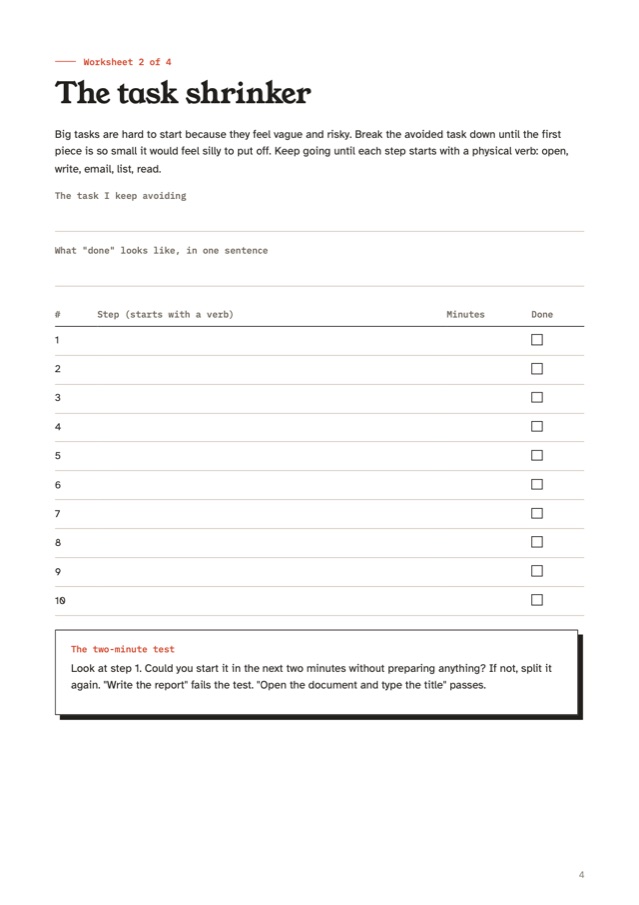
A task breakdown worksheet helps you split a large, vague task into small concrete steps. The key rule is that each step starts with a physical verb (open, write, email, list) and the first step takes under two minutes. Large, unclear tasks feel unpleasant, and how unpleasant a task feels is one of the most reliable predictors of procrastination (Steel, 2007). Shrinking the task changes how it feels to start.
How to fill in the worksheet
- Write the task you keep avoiding in the top box, in your own words.
- Write what 'done' looks like in one sentence. 'Report sent to Sam' is clearer than 'finish the report'.
- List the steps in order, each starting with a verb. Don't worry about getting them all; five is fine.
- Estimate minutes for each step. Anything over 30 minutes is probably two steps.
- Apply the two-minute test to step 1. If you couldn't start it in the next two minutes without preparing anything, split it again.
An example
| The task | Do my tax return |
|---|
| Done looks like | Return submitted on the HMRC website |
|---|
| Step 1 | Open the HMRC login page and find my password (2 min) |
|---|
| Step 2 | Download last year's bank statements (10 min) |
|---|
| Step 3 | List income sources on one sheet (15 min) |
|---|
| Step 4 | Enter income figures into the form (20 min) |
|---|
Why breaking tasks down works
Procrastination is mainly about avoiding a bad feeling, and big vague tasks produce more of it: you can't see where to start, so every attempt feels like failing. Steel's meta-analysis found task aversiveness was one of the strongest predictors of delay. A small, specific first step is far less aversive, and once you've started, the next step is clearer. The verb rule matters because 'research' or 'think about' can't be done in two minutes, while 'open the folder' can.
Common mistakes
- Steps that are still projects. 'Write chapter 2' is not a step. 'Write the first heading of chapter 2' is.
- Planning instead of doing. Once step 1 passes the two-minute test, stop planning and do it.
- Breaking down every task you have. Use it on the one task you keep avoiding.
- Skipping the 'done' line. Without it, tasks quietly grow while you work on them.
More free worksheets
Questions
How do you break down a task you keep avoiding?
Write what 'done' looks like, then list steps that each start with a verb like open, write or email. Keep splitting until the first step takes under two minutes and you could start it right now without preparing anything.
What is the two-minute test?
Look at your first step and ask whether you could start it in the next two minutes without preparing anything. 'Write the report' fails. 'Open the document and type the title' passes. If it fails, split it again.
How small should a first step be?
Small enough that it would feel silly to put off, usually under two minutes. The aim isn't to finish anything, it's to make starting easy.
Is this worksheet free?
Yes. Download the one-page PDF directly, no email needed. The full pack with the if-then plan, brain dump and daily planner is also free with your email.
The research behind this worksheet
Steel, P. (2007). The nature of procrastination: A meta-analytic and theoretical review of quintessential self-regulatory failure. Psychological Bulletin, 133(1), 65–94. https://doi.org/10.1037/0033-2909.133.1.65
Sirois, F. M., & Pychyl, T. A. (2013). Procrastination and the priority of short-term mood regulation: Consequences for future self. Social and Personality Psychology Compass, 7(2), 115–127. https://doi.org/10.1111/spc3.12011
Related
Download the task breakdown worksheet
Free one-page PDF, no email needed.