The short answer
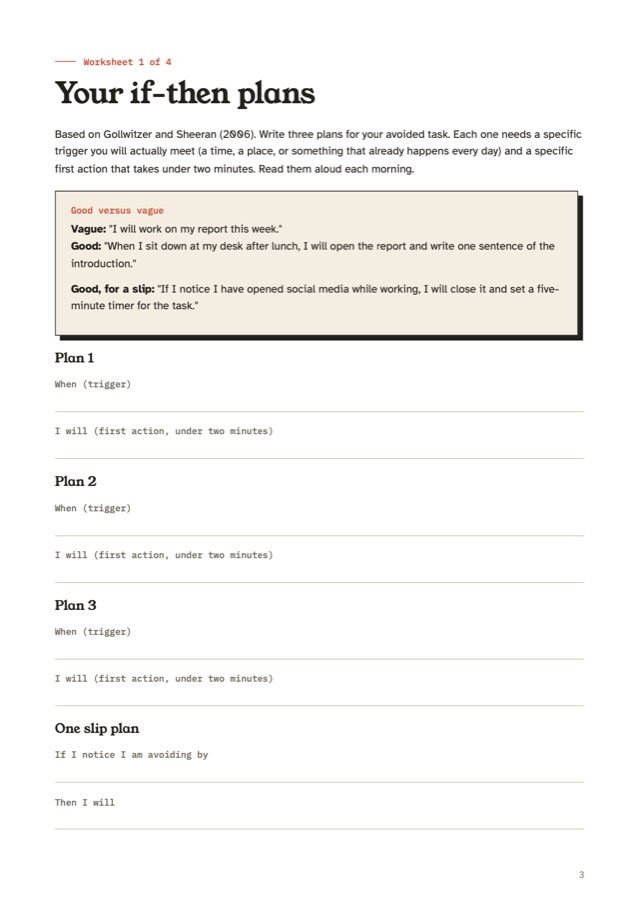
An if-then plan template is a worksheet for writing implementation intentions: plans in the form 'When [situation], I will [action].' You pick a specific moment you will definitely meet, like sitting down after lunch, and link it to a first action that takes under two minutes. Across 94 studies, plans like this had a medium-to-large effect on reaching goals (Gollwitzer & Sheeran, 2006).
How to fill in the template
- Pick the one task you keep avoiding. You'll write three plans for it.
- For each 'When', pick a trigger you will actually meet: a time ('at 9am'), a place ('when I sit at my desk') or something that already happens every day ('after I put the kettle on').
- For each 'I will', write a first action that takes under two minutes and starts with a verb: open, write, email, list.
- Fill in the slip plan: 'If I notice I'm avoiding by [your usual escape], then I will [small return action].'
- Read all four plans aloud each morning for the next week.
Good versus vague
| Vague | I will work on my report this week. |
|---|
| Good | When I sit down at my desk after lunch, I will open the report and write one sentence of the introduction. |
|---|
| Vague | I'll stop scrolling and study more. |
|---|
| Good, for a slip | If I notice I've opened social media while studying, I will close it and set a five-minute timer for my notes. |
|---|
Why if-then plans work
Deciding in advance takes the decision out of the moment when you're most likely to dodge it. The situation becomes a cue that starts the action almost automatically, so you don't have to rely on motivation when the moment arrives. Gollwitzer and Sheeran's meta-analysis pooled 94 independent tests and found a medium-to-large effect on goal achievement, and the effect held for getting started on tasks, which is exactly where procrastination bites. A plan is weakest when the trigger is vague ('sometime this afternoon'), so the template asks for a specific moment.
Common mistakes
- A trigger you might not meet. 'When I feel motivated' never arrives. Use a time, place or routine.
- An action that's too big. 'I will write the essay' is a goal, not a first action. Shrink it until it takes two minutes.
- Too many plans. Three for one task is plenty. Ten plans for ten tasks is a new to-do list.
- Writing it and never reading it again. Read the plans aloud each morning, at least for the first week.
More free worksheets
Questions
What is an if-then plan?
An if-then plan, or implementation intention, links a specific situation to a specific action: 'When I sit down after lunch, I will open the report.' It was developed by psychologist Peter Gollwitzer, and a meta-analysis of 94 studies found it has a medium-to-large effect on reaching goals.
How many if-then plans should I write?
Three for the task you're avoiding, plus one slip plan for when you catch yourself putting it off. More than that for a single task tends to dilute them.
What is a good example of an implementation intention?
'When I sit down at my desk after lunch, I will open the report and write one sentence of the introduction.' It names a moment you'll definitely meet and an action that takes under two minutes. 'I'll work on my report this week' is the vague version that doesn't work.
Is this template free?
Yes. Download the one-page PDF directly, no email needed. The full pack with the task shrinker, brain dump and daily planner is also free with your email.
The research behind this worksheet
Gollwitzer, P. M., & Sheeran, P. (2006). Implementation intentions and goal achievement: A meta-analysis of effects and processes. Advances in Experimental Social Psychology, 38, 69–119. https://doi.org/10.1016/S0065-2601(06)38002-1
Gollwitzer, P. M. (1999). Implementation intentions: Strong effects of simple plans. American Psychologist, 54(7), 493–503. https://doi.org/10.1037/0003-066X.54.7.493
Related
Download the if-then plan template
Free one-page PDF, no email needed.