The short answer
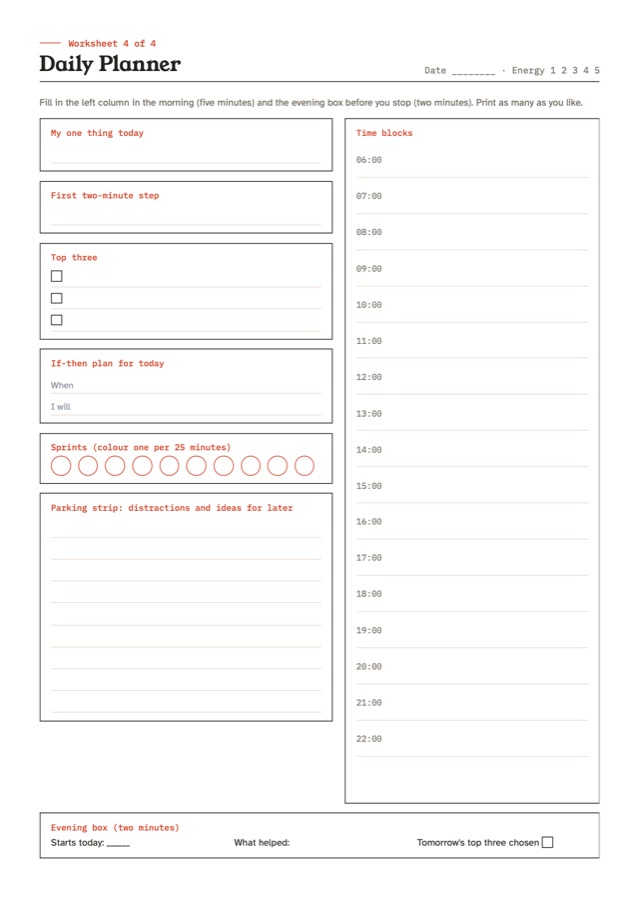
A daily planner for procrastinators puts the first step before the schedule. Instead of a list of everything, it asks for one thing, the two-minute action that starts it, and a specific time to do it. This planner adds time blocks, a 25-minute sprint tracker and an evening box that counts how many times you started, because starting is the part procrastination blocks.
How to use the planner
- Morning, five minutes: write your one thing and its first two-minute step. Add a top three.
- Write today's if-then plan: 'When [moment], I will [first step].'
- Block the time for your one thing in the time column, ideally when your energy is highest.
- During the day: colour one circle per 25-minute sprint, and write distracting thoughts on the parking strip instead of acting on them.
- Evening, two minutes: write how many times you started, what helped, and choose tomorrow's top three.
Why it's built this way
Most planners are built for people who already start easily and need to organise their time. Procrastination is a different problem: you know what to do and delay anyway, usually because the task feels bad (Sirois & Pychyl, 2013). So this planner leads with the one thing and a tiny first step, links it to a moment with an if-then plan, and counts starts rather than hours. The parking strip handles the other common failure: a stray thought ('I should check that email') that turns into twenty minutes elsewhere.
Time blocking without the guilt
Time blocks help when they protect a slot for the hard task, and hurt when an overpacked schedule becomes one more thing to fail at. Block only your one thing and one or two other fixed commitments. Leave the rest of the column empty. If a block slips, move it later in the day rather than abandoning it, and if a whole day slips, start fresh with tomorrow's page. Students who forgave themselves for procrastinating procrastinated less on the next exam (Wohl, Pychyl & Bennett, 2010).
More free worksheets
Questions
What should a daily planner for procrastination include?
A single priority, the two-minute first step that starts it, a specific time to do it, and a way to count starts. Distraction capture and a short evening review help too. A long to-do list on its own tends to make procrastination worse.
What size is the printable planner?
A4, and it prints fine on US Letter. It's designed to use little ink.
Can I use it on an iPad?
Yes. Open the PDF in GoodNotes, Notability or a similar app and write on it. Duplicate the page each day.
Is this planner free?
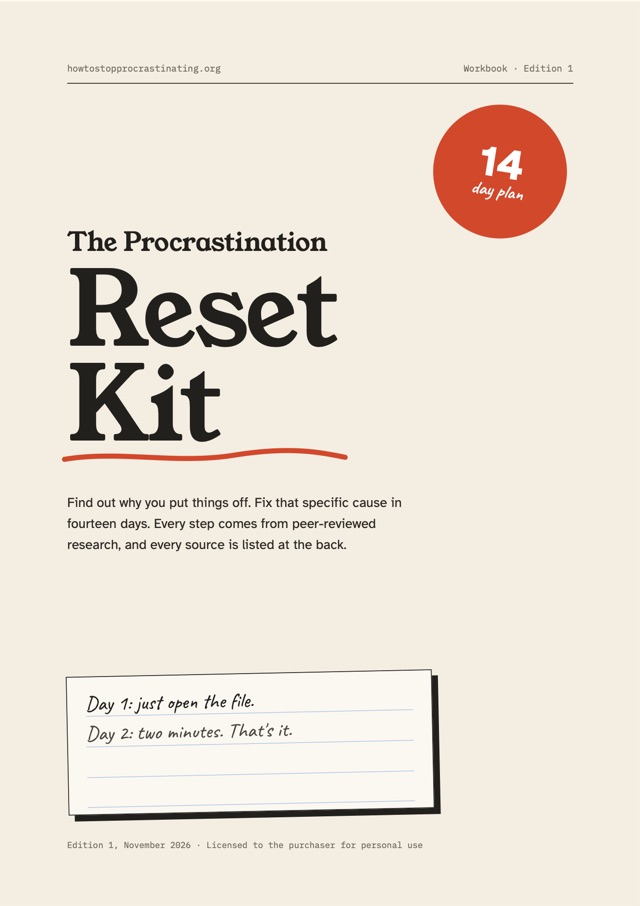
Yes. Download the one-page PDF directly, no email needed. The Procrastination Reset Kit has 14 versions with each day's focus filled in, plus a start tracker and weekly reviews.
The research behind this worksheet
Sirois, F. M., & Pychyl, T. A. (2013). Procrastination and the priority of short-term mood regulation: Consequences for future self. Social and Personality Psychology Compass, 7(2), 115–127. https://doi.org/10.1111/spc3.12011
Gollwitzer, P. M., & Sheeran, P. (2006). Implementation intentions and goal achievement: A meta-analysis of effects and processes. Advances in Experimental Social Psychology, 38, 69–119. https://doi.org/10.1016/S0065-2601(06)38002-1
Wohl, M. J. A., Pychyl, T. A., & Bennett, S. H. (2010). I forgive myself, now I can study: How self-forgiveness for procrastinating can reduce future procrastination. Personality and Individual Differences, 48(7), 803–808. https://doi.org/10.1016/j.paid.2010.01.029
Related
Download the printable daily planner
Free one-page PDF, no email needed.