Willpower by Roy Baumeister and John Tierney, an honest summary
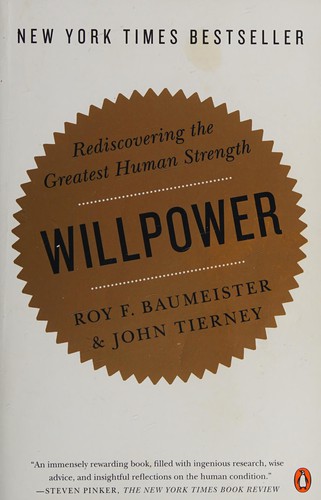
Willpower (2011) argues self-control is a limited resource that depletes with use like a muscle, is fed by glucose, and can be strengthened with practice. It applies this to dieting, decision fatigue and procrastination. Its central theory, ego depletion, has since failed large pre-registered replications, which makes this an unusual entry: a well-written book about a finding that mostly did not hold.
| Author | Roy F. Baumeister and John Tierney |
|---|---|
| Published | 2011 |
| Core framework | Ego depletion: willpower as a depletable, glucose-fuelled resource; conserve it, strengthen it, structure around it |
| Maps to techniques | Precommitment devices, environment design, implementation intentions |
The ideas that hold up
- Its practical conclusion survives even though its mechanism did not: people with high self-control succeed mainly by arranging their lives to avoid temptation, not by resisting harder, which later research confirmed independently.
- Precommitment, binding your future self before the moment of choice, has solid evidence regardless of what willpower is.
- The Zeigarnik-style advice that writing down a plan quiets an unfinished task's mental nagging has direct experimental support and is genuinely useful against task-related rumination.
- Monitoring, standards and tracking as pillars of self-control remain reasonable and are echoed across the behaviour-change literature.
Take with a pinch of salt
- The core theory is the problem: a 2016 multi-lab registered replication of ego depletion found an effect near zero, and the glucose claims fared even worse; large parts of this book describe effects that likely do not exist as stated.
- The decision-fatigue showpieces, like the hungry-judges parole study, have strong alternative explanations and should not be repeated as fact.
- For procrastination specifically, the frame is subtly harmful if taken literally: treating delay as a fuel shortage points you at rest and sugar rather than at the task aversion actually driving it.
Built on Baumeister's own once-dominant research programme; the depletion and glucose findings subsequently failed replication, while the avoid-temptation and planning findings stand on independent evidence.
Hagger, M. S., Chatzisarantis, N. L. D., et al. (2016). A multilab preregistered replication of the ego-depletion effect. Perspectives on Psychological Science, 11(4), 546-573. https://doi.org/10.1177/1745691616652873
Hofmann, W., Baumeister, R. F., Förster, G., & Vohs, K. D. (2012). Everyday temptations: An experience sampling study of desire, conflict, and self-control. Journal of Personality and Social Psychology, 102(6), 1318-1335. https://doi.org/10.1037/a0026545
Related
Precommitment devicesEnvironment design
Frequently asked questions
Is Willpower still worth reading?
Only with the replication history in hand. The writing is good and some advice survives, especially precommitment and avoiding temptation rather than resisting it. But its central claim, that willpower depletes like fuel, is one of psychology's most prominent replication failures, and newer books build on firmer ground.