The Procrastination Equation by Piers Steel, an honest summary
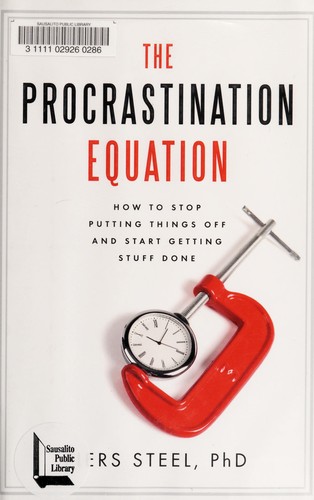
The Procrastination Equation (2011) argues that motivation equals expectancy times value, divided by impulsiveness times delay: you put things off when success feels unlikely, the task feels worthless, the payoff is distant, or you are impulsive. Fix the weak variable, not procrastination in general. Steel wrote the 2007 meta-analysis that much of the field still cites.
| Author | Piers Steel |
|---|---|
| Published | 2011 |
| Core framework | Motivation = (expectancy x value) / (impulsiveness x delay); diagnose which variable is failing, then target it |
| Maps to techniques | Implementation intentions, precommitment devices, temptation bundling, goal setting |
The ideas that hold up
- The equation itself is a serious model: temporal motivation theory synthesises expectancy theory, hedonic value and hyperbolic discounting, and it fits the data on why deadlines suddenly produce action.
- The diagnostic framing is the book's most practical export: low expectancy needs confidence-building and small wins, low value needs meaning or bundled rewards, high impulsiveness needs precommitment and cue control.
- Its claim that impulsiveness is the strongest personality predictor of procrastination comes straight from Steel's own meta-analysis of nearly 700 studies, and later work has held it up.
- The recommended tactics, success spirals, temptation bundling, removing cues, and binding your future self, all have independent evidence behind them.
Take with a pinch of salt
- It reads more like a research summary with advice attached than a usable programme; readers wanting a step-by-step system often bounce off it.
- The equation describes motivation well but underweights the emotion side: shame, anxiety and task aversion get less space here than the post-2013 mood-regulation literature gives them.
- Some chapters wander into societal commentary on advertising and temptation that is interesting but not actionable.
Unusually for this shelf, the book is built directly on peer-reviewed work, much of it the author's own. Its main blind spot is the emotion-regulation account that gained ground after publication.
Steel, P. (2007). The nature of procrastination: A meta-analytic and theoretical review of quintessential self-regulatory failure. Psychological Bulletin, 133(1), 65-94. https://doi.org/10.1037/0033-2909.133.1.65
Steel, P., & König, C. J. (2006). Integrating theories of motivation. Academy of Management Review, 31(4), 889-913. https://doi.org/10.5465/amr.2006.22527462
Related
Implementation intentionsTemptation bundlingPrecommitment devices
Frequently asked questions
Is The Procrastination Equation worth reading?
If you want to understand why you procrastinate rather than just collect tactics, it is the best-evidenced book available, written by a leading researcher in the field. If you want a simple programme to follow this week, start with a lighter book and come back.