Solving the Procrastination Puzzle by Timothy Pychyl, an honest summary
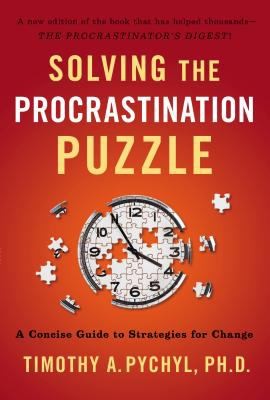
Solving the Procrastination Puzzle (2013) is a concise guide by Timothy Pychyl, who ran the Procrastination Research Group at Carleton University. Its central claim is that procrastination is emotion regulation gone wrong, not a time-management failure, and its main prescription is to just get started, because task aversion is mostly anticipatory.
| Author | Timothy A. Pychyl |
|---|---|
| Published | 2013 |
| Core framework | Procrastination as short-term mood repair; 'just get started' plus implementation intentions |
| Maps to techniques | Implementation intentions, Two-Minute Rule, time blocking |
The ideas that hold up
- Procrastination as emotion regulation, giving in to feel good now at the cost of your future self, is the mainstream research position, developed with Fuschia Sirois.
- The 'just get started' advice rests on the finding that once people begin, the task usually feels less aversive than they predicted.
- Implementation intentions ('if it is 9am, then I open the draft') are among the best-replicated tools in behaviour change, and the book uses them correctly.
- It is honest about willpower: the advice is to lower the bar for starting rather than to try harder.
Take with a pinch of salt
- It is deliberately short, so people wanting detailed systems for email, projects or capture will find little; it pairs well with a systems book like Getting Things Done.
- Some of the self-report research it draws on has the usual limitations of correlational student samples.
- Readers with ADHD may need more than the book offers; it addresses typical procrastination, not executive-function differences.
Unusually for this genre, the author is a primary researcher in the field; the book summarises the emotion-regulation account of procrastination and the implementation-intentions literature.
Sirois, F., & Pychyl, T. (2013). Procrastination and the priority of short-term mood regulation: Consequences for future self. Social and Personality Psychology Compass, 7(2), 115–127. https://doi.org/10.1111/spc3.12011
Gollwitzer, P. M., & Sheeran, P. (2006). Implementation intentions and goal achievement: A meta-analysis of effects and processes. Advances in Experimental Social Psychology, 38, 69–119. https://doi.org/10.1016/S0065-2601(06)38002-1
Related
Pychyl interviewed at length (video)Implementation intentionsTwo-Minute Rule
Frequently asked questions
What is the best book on procrastination?
If you only read one, this is the safest pick: it is short, written by a researcher who studied procrastination directly, and its advice matches the current evidence. Read Atomic Habits afterwards if you want a broader habit system.
Is Solving the Procrastination Puzzle worth reading?
Yes. It takes about two hours and its core moves, treat procrastination as an emotion problem and use if-then plans to get started, are the two best-supported interventions available.