Thomas Frank's number-one method, reviewed: it's the Pomodoro cousin
Thomas Frank's 2017 video presents his favourite anti-procrastination move: commit to a short, timed burst of work with permission to stop afterwards, which lowers the cost of starting enough that starting actually happens. It is the getting-started principle in student-friendly packaging.
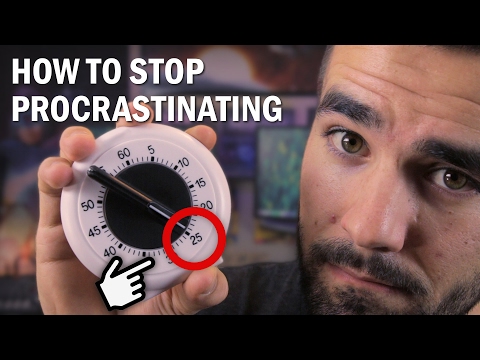
Watching loads the player from youtube-nocookie.com. Video by Thomas Frank (College Info Geek); embedded for review purposes.
| Creator | Thomas Frank (College Info Geek) |
|---|---|
| Length | 7 minutes |
| Published | 2017 |
| Type | Creator explainer |
| Best for | A quick, low-friction way to start when starting is the whole problem |
What the video argues
Frank's claim is that the hardest part of any avoided task is the first few minutes, so the fix is to shrink the commitment: set a timer for a short sprint, give yourself genuine permission to quit when it rings, and rely on the fact that once moving, you usually keep moving. It is the same family as the Pomodoro technique and the two-minute rule, delivered with the practical, exam-season energy that made his channel a student staple.
Where it aligns with the research
The core move is well supported by adjacent evidence. Pychyl's work shows people feel better about a task shortly after starting than they predicted, which is exactly the momentum effect Frank leans on, and the unfinished-task tension described by the Zeigarnik effect points the same way. Time-boxed sprints themselves have not been trialled as a procrastination treatment, but as an application of 'just get started' the advice is on safe ground.
The honest criticism
It cites nothing and it is one tactic, not a framework: nothing on why the task is aversive, nothing for the person whose problem is returning to work after the sprint ends, and the production has aged. But at seven minutes the cost of watching is trivial, and the move it teaches is one of the few that works on the very worst days. A fair entry point that should hand you on to a fuller method.
Uncited creator advice whose central mechanism, that starting is the barrier and mood improves once you begin, matches experience-sampling research.
Pychyl, T. A., Lee, J. M., Thibodeau, R., & Blunt, A. (2000). Five days of emotion: An experience sampling study of undergraduate student procrastination. Journal of Social Behavior and Personality, 15(5), 239-254.
Related
The Pomodoro techniqueThe two-minute ruleWhy starting changes how the task feels
Frequently asked questions
How is this different from the Pomodoro technique?
It is looser: no fixed 25-minute interval, no cycle of breaks, just one short committed sprint with permission to stop. Think of it as Pomodoro's informal cousin, useful when even a full Pomodoro feels like too much.