Tiny Habits by BJ Fogg, an honest summary
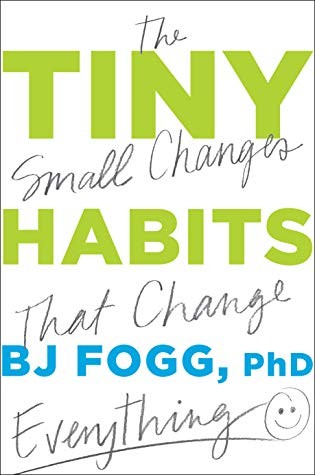
Tiny Habits (2020) argues that behaviour happens when motivation, ability and a prompt converge, and since motivation is unreliable, design for ability: shrink the habit to something near-effortless (floss one tooth, two push-ups), anchor it after an existing routine, and celebrate instantly to wire it in. Fogg ran the Stanford Behavior Design Lab and taught many of the field's popularisers.
| Author | BJ Fogg |
|---|---|
| Published | 2020 |
| Core framework | B=MAP (behaviour = motivation, ability, prompt); anchor, tiny behaviour, celebration |
| Maps to techniques | Habit stacking, two-minute rule, implementation intentions |
The ideas that hold up
- Designing for low motivation is exactly right for procrastination: plans that require feeling like it fail on the days that matter, and tiny entry points do not.
- Anchoring a new behaviour to an existing routine is a form of implementation intention, one of the best-evidenced techniques in behaviour change.
- Shrinking the task attacks the start-up aversion directly; it is the same mechanism as the two-minute rule, and starting reliably predicts continuing.
- Troubleshooting failures as design flaws rather than character flaws removes the shame spiral that keeps many procrastinators stuck.
Take with a pinch of salt
- The instant-celebration step is the model's most original and least evidenced claim; the emotion-wires-habits mechanism is plausible but not demonstrated at the level of Fogg's confidence, and many readers find deliberate celebration unnatural.
- B=MAP is presented as settled science; it is a useful heuristic from design practice more than a validated psychological law.
- Tiny habits build routines well but scale awkwardly to big one-off projects; a thesis is not a habit, and the book says less about that case.
Grounded in Fogg's lab and consulting work rather than published trials of the method itself; its anchoring component borrows the strength of the implementation-intentions literature.
Gollwitzer, P. M., & Sheeran, P. (2006). Implementation intentions and goal achievement: A meta-analysis of effects and processes. Advances in Experimental Social Psychology, 38, 69-119. https://doi.org/10.1016/S0065-2601(06)38002-1
Related
Habit stackingTwo-minute ruleImplementation intentions
Frequently asked questions
Tiny Habits or Atomic Habits?
They share DNA; Clear credits Fogg's ideas and both use anchoring and shrinking. Atomic Habits is broader and better written; Tiny Habits is more precise about the mechanics of one habit at a time and more forgiving in tone. For pure getting-started problems, Fogg's version is the sharper tool.