The ONE Thing by Gary Keller, an honest summary
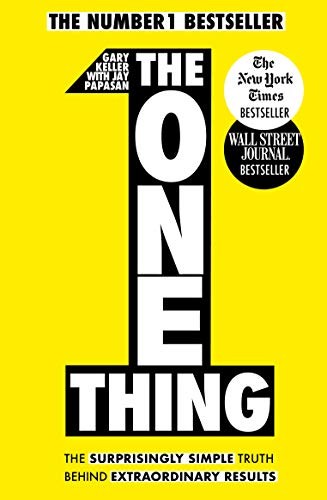
The ONE Thing (2013) argues that extraordinary results come from narrowing focus: ask 'What is the ONE thing I can do such that by doing it everything else becomes easier or unnecessary?', then protect a large daily time block for it and treat everything else as second. For procrastinators its main export is a single, unambiguous priority.
| Author | Gary Keller, with Jay Papasan |
|---|---|
| Published | 2013 |
| Core framework | The focusing question, goal setting to the now, four-hour time blocks, saying no to everything second |
| Maps to techniques | Eat the frog, time blocking, deep work |
The ideas that hold up
- A single named priority removes the decision friction that fuels delay: much procrastination happens while choosing between tasks, not while doing them.
- Protecting a recurring morning block for the priority is time blocking plus eat-the-frog, both of which have reasonable practical support.
- The chapter debunking multitasking is on solid ground: task-switching costs are among the better replicated findings in attention research.
- 'Goal setting to the now', chaining a long-term goal down to what to do today, is a usable antidote to the vagueness that makes big goals easy to avoid.
Take with a pinch of salt
- The book repeats the claim that habits take an average of 66 days from a single small study of everyday behaviours; the real range in that study ran from 18 to 254 days.
- The domino metaphor and 'everything else becomes unnecessary' framing oversell how neatly one task cascades in most jobs.
- A four-hour daily block for one priority is realistic for a business owner with staff, which Keller is, and much harder for anyone whose calendar belongs to other people.
Cites real research on multitasking, willpower and habit formation, but leans on it selectively; the core advice stands better on practical grounds than on the studies quoted.
Lally, P., van Jaarsveld, C. H. M., Potts, H. W. W., & Wardle, J. (2010). How are habits formed: Modelling habit formation in the real world. European Journal of Social Psychology, 40(6), 998-1009. https://doi.org/10.1002/ejsp.674
Rubinstein, J. S., Meyer, D. E., & Evans, J. E. (2001). Executive control of cognitive processes in task switching. Journal of Experimental Psychology: Human Perception and Performance, 27(4), 763-797. https://doi.org/10.1037/0096-1523.27.4.763
Related
Frequently asked questions
Is The ONE Thing just Eat That Frog with more pages?
They overlap heavily: both say identify the most important task and do it first. The ONE Thing adds the focusing question and pushes for a much larger protected block, four hours rather than one task. If you have read one, the marginal value of the other is modest.