Stolen Focus by Johann Hari, an honest summary
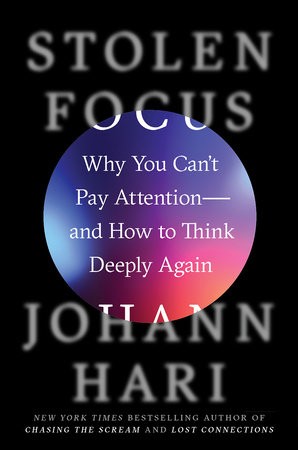
Stolen Focus (2022) argues that shrinking attention is not a personal failing but the product of twelve forces, surveillance-capitalist app design, constant switching, sleep loss, diet, stress and more, and that the fix is partly political, not just individual. It reframes focus problems, and by extension a lot of procrastination, as environmental rather than moral.
| Author | Johann Hari |
|---|---|
| Published | 2022 |
| Core framework | Twelve societal causes of attention decline; individual mitigations plus collective 'attention rebellion' |
| Maps to techniques | Environment design, deep work, dopamine detox |
The ideas that hold up
- Task-switching costs are real and well replicated; the book's account of what constant interruption does to working depth matches the attention literature.
- The business-model argument is its strongest ground: feeds are optimised for engagement by some of the best-resourced engineering teams in history, and treating resistance as a pure willpower contest misdescribes the fight.
- Linking sleep loss and chronic stress to poor attention is uncontroversial, and productivity books usually ignore both.
- Lifting blame off the individual is therapeutic for chronic procrastinators, whose shame typically makes avoidance worse rather than better.
Take with a pinch of salt
- Several researchers Hari interviewed disputed his use of their work, and the headline attention-decline statistics rest on thin or contested evidence; the book states confidently what the field states cautiously.
- Hari's history matters here: he left journalism in 2011 over fabricated quotes and plagiarism, which is fair context for a book built on interview material.
- It is diagnosis, not treatment: beyond precommitment devices and going offline, there is little you can do with it, and the political remedies are outside any reader's short-term control.
Built on interviews with attention researchers; the switching-cost material is solid, but some causal claims, especially around measured attention decline, go beyond what the cited scientists endorse.
Rubinstein, J. S., Meyer, D. E., & Evans, J. E. (2001). Executive control of cognitive processes in task switching. Journal of Experimental Psychology: Human Perception and Performance, 27(4), 763-797. https://doi.org/10.1037/0096-1523.27.4.763
Related
Frequently asked questions
Is Stolen Focus scientifically accurate?
Mixed. The interruption and sleep material reflects mainstream research, but several claims, including how much average attention spans have declined, are stated with more certainty than the evidence supports, and some interviewed researchers objected to how their work was framed. Read it for the systemic argument, verify the statistics.