Make Time by Jake Knapp and John Zeratsky, an honest summary
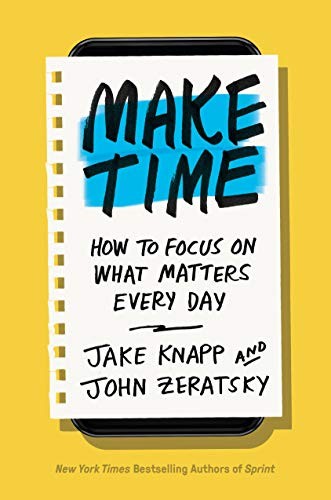
Make Time (2018) argues you do not need more discipline, you need defaults that favour focus: choose one 'highlight' for the day, use 'laser' tactics to keep attention on it, manage energy, then reflect and adjust. Its villains are 'infinity pools', apps with bottomless feeds designed to consume attention. It is a menu of 87 tactics to experiment with, not a doctrine.
| Author | Jake Knapp and John Zeratsky |
|---|---|
| Published | 2018 |
| Core framework | Highlight, laser, energize, reflect; redesign defaults instead of relying on willpower |
| Maps to techniques | Time blocking, environment design, dopamine detox-style feed removal |
The ideas that hold up
- The daily highlight is a well-sized commitment: one 60 to 90 minute priority is concrete enough to schedule and small enough to start, which is exactly the range where procrastinators do best.
- Treating distraction as a design problem, log out, remove apps, make the phone boring, applies the strongest finding in self-control research: changing the situation beats resisting in the moment.
- The experiment framing lowers the stakes of failure; trying one tactic for a week is more sustainable than adopting a whole system, and abandoning a whole system is how most productivity books end.
- Both authors helped build the attention economy at Google and YouTube, which makes the infinity-pools chapter unusually credible.
Take with a pinch of salt
- It is deliberately unscientific: the authors present tactics from personal experiment, and almost nothing is cited, so treat every claim as a hypothesis to test on yourself.
- The energy section leans on conventional wisdom about caffeine, exercise and sleep; fine advice, thin evidence as presented.
- If your procrastination has an anxiety or perfectionism root, a tactic menu will not reach it; this book treats delay as a defaults problem only.
Explicitly experience-based rather than research-based, but its two core moves, one concrete daily priority and situational distraction control, match well-supported findings it never cites.
Duckworth, A. L., Gendler, T. S., & Gross, J. J. (2016). Situational strategies for self-control. Perspectives on Psychological Science, 11(1), 35-55. https://doi.org/10.1177/1745691615623247
Related
Time blockingEnvironment design
Frequently asked questions
Is Make Time good for procrastinators?
It is one of the friendlier entry points. The highlight gives you one thing to start, the laser tactics remove the escape hatches, and the experiment framing means a bad day is data rather than failure. Readers who need to understand why they procrastinate should pair it with something more evidence-based.