Hyperfocus by Chris Bailey, an honest summary
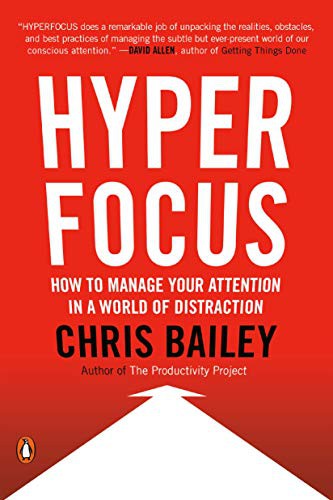
Hyperfocus (2018) argues that attention is the real productivity bottleneck: attentional space is small, so choose one object of attention, clear distractions in advance, and enter 'hyperfocus'. Its counterpart, 'scatterfocus', is deliberate mind-wandering for planning and creative connections. It is a focus book more than a procrastination book.
| Author | Chris Bailey |
|---|---|
| Published | 2018 |
| Core framework | Manage attentional space; hyperfocus for execution, scatterfocus for creativity, distraction-clearing in advance |
| Maps to techniques | Deep work, environment design, pomodoro-style intention setting |
The ideas that hold up
- The working-memory framing is broadly right: attentional capacity is tightly limited, and holding one clear intention at a time fits how it actually works.
- Clearing distractions before starting, rather than resisting them mid-task, matches the consistent finding that situation change beats in-the-moment willpower.
- Setting a specific intention before a focus session is a low-cost habit with real support from the implementation-intentions literature.
- Scatterfocus is a fair reading of the mind-wandering and incubation research: unfocused time genuinely helps with planning and creative connections.
Take with a pinch of salt
- The book uses 'hyperfocus' to mean deliberate, healthy focus; in the ADHD literature the same word means involuntary absorption you cannot steer, which confuses readers who arrive from that context.
- Procrastination gets a light touch: if your problem is aversion to starting, this book assumes a willingness to begin that you may not have.
- Some cited figures, like checking email dozens of times a day, come from small or informal studies and are best read as illustrations rather than facts.
Draws genuinely on attention and mind-wandering research and interviews with researchers; interpretations are sometimes more confident than the underlying studies.
Smallwood, J., & Schooler, J. W. (2015). The science of mind-wandering: Empirically navigating the stream of consciousness. Annual Review of Psychology, 66, 487-518. https://doi.org/10.1146/annurev-psych-010814-015331
Gollwitzer, P. M., & Sheeran, P. (2006). Implementation intentions and goal achievement: A meta-analysis of effects and processes. Advances in Experimental Social Psychology, 38, 69-119. https://doi.org/10.1016/S0065-2601(06)38002-1
Related
Frequently asked questions
Hyperfocus or Deep Work, which should I read?
Deep Work argues for why long focused work matters to a career; Hyperfocus is more mechanical about how attention works hour to hour, and adds deliberate mind-wandering. Newport is the stronger argument, Bailey the gentler manual. Neither is primarily about the urge to avoid starting.