Feel-Good Productivity by Ali Abdaal, an honest summary
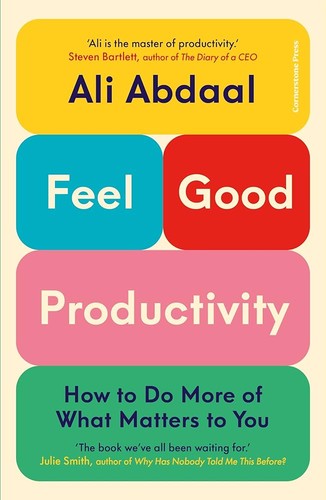
Feel-Good Productivity (2023) argues the discipline model is backwards: positive emotion fuels energy and output, so make work feel better through play, power (confidence) and people. Its middle section diagnoses procrastination as three blockers, uncertainty, fear and inertia, and offers unblocking tools like defining next steps, the 10/10/10 rule and reducing friction.
| Author | Ali Abdaal |
|---|---|
| Published | 2023 |
| Core framework | Energise (play, power, people), unblock (uncertainty, fear, inertia), sustain (avoid burnout) |
| Maps to techniques | Temptation bundling, habit stacking, two-minute rule, five-second-style starts |
The ideas that hold up
- The core direction of travel is consistent with the research: procrastination is now widely modelled as mood repair, so making the task feel better attacks the actual mechanism rather than the symptom.
- Diagnosing delay as uncertainty, fear or inertia is a usable triage; 'define the next physical action' for uncertainty paralysis is GTD's best idea restated.
- Reducing friction and adding play to aversive tasks is temptation bundling by another name, and that has trial evidence behind it.
- The burnout section's point that relentless output collapses without recovery is uncontroversial and often missing from productivity books aimed at young audiences.
Take with a pinch of salt
- The endnotes look dense, but many citations support the framing loosely; 'feeling good boosts creativity' style claims rest on the broaden-and-build literature, which has had a mixed replication record.
- Abdaal's evidence is heavily his own experience as a doctor turned YouTuber, an unusually autonomy-rich career; the tactics port less cleanly to shift work or caring responsibilities.
- Readers of the genre will recognise most tools from earlier books; the packaging is newer than the content.
Cites widely, from self-determination theory to positive-emotion research, but often as illustration rather than support; the procrastination triage is sensible and consistent with the mood-repair account.
Sirois, F., & Pychyl, T. (2013). Procrastination and the priority of short-term mood regulation: Consequences for future self. Social and Personality Psychology Compass, 7(2), 115-127. https://doi.org/10.1111/spc3.12011
Ryan, R. M., & Deci, E. L. (2000). Self-determination theory and the facilitation of intrinsic motivation, social development, and well-being. American Psychologist, 55(1), 68-78. https://doi.org/10.1037/0003-066X.55.1.68
Related
Temptation bundlingTwo-minute rule
Frequently asked questions
Is Feel-Good Productivity backed by science?
Partly. Its central claim, that improving how a task feels beats forcing yourself through it, aligns with the emotion-regulation model of procrastination. But many individual studies are cited as decoration, and the book is best read as well-organised practical advice rather than a research summary.