Eat That Frog! by Brian Tracy, an honest summary
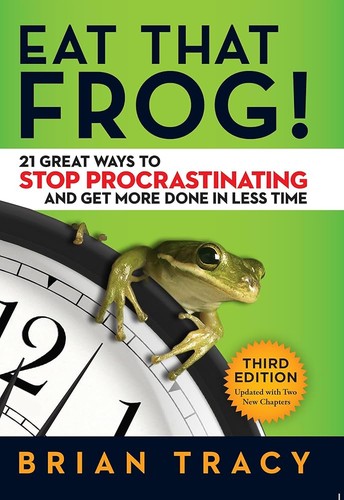
Eat That Frog! (2001) is a collection of 21 short prioritisation rules built around one memorable instruction: identify your most important, most-resisted task (the frog) and do it first thing each day, before easier work eats the morning. It named the eat-the-frog technique, which is now used far beyond the book.
| Author | Brian Tracy |
|---|---|
| Published | 2001 |
| Core framework | Do the hardest, highest-value task first; 21 supporting prioritisation rules |
| Maps to techniques | Eat the frog, time blocking, implementation intentions |
The ideas that hold up
- Doing the aversive task first exploits the fact that self-control is most reliable early in the day and removes the option of hiding in easy work.
- Deciding your frog the night before is an implementation intention in practice: the morning starts with a pre-made decision instead of a negotiation.
- The insistence on written, specific goals aligns with goal-setting research showing specific goals outperform vague ones.
Take with a pinch of salt
- It is a motivational sales-training book, not a researched one; almost no claims are cited, and several statistics are repeated folklore.
- The 21 rules overlap heavily, and the core content would fit in a long article.
- For anxiety-driven procrastinators, 'attack your worst task at 8am' can backfire; the book has no account of why people avoid tasks, only that they should stop.
The book cites little research directly, but its central move is compatible with goal-setting and self-control findings; the technique it named has more evidence behind it than the book offers.
Locke, E. A., & Latham, G. P. (2002). Building a practically useful theory of goal setting and task motivation: A 35-year odyssey. American Psychologist, 57(9), 705–717. https://doi.org/10.1037/0003-066X.57.9.705
Related
Eat the frog (the technique)Implementation intentions
Frequently asked questions
Is Eat That Frog worth reading?
The core idea is genuinely useful and you can learn it from the first chapter, or from our eat-the-frog technique page. Read the whole book only if you enjoy the motivational format.