Deep Work by Cal Newport, an honest summary
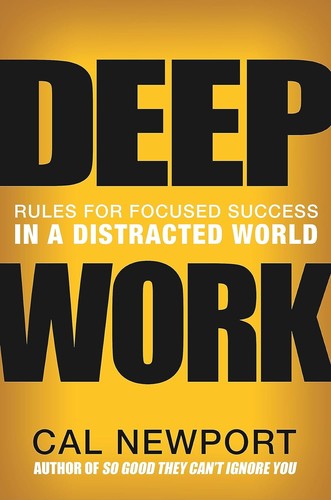
Deep Work (2016) argues that the ability to focus without distraction on cognitively demanding tasks is both increasingly rare and increasingly valuable, and that you should build your working life around protected blocks of it. For procrastinators, its useful exports are time blocking, ritualised start routines, and aggressive reduction of shallow obligations.
| Author | Cal Newport |
|---|---|
| Published | 2016 |
| Core framework | Deep vs shallow work; schedule depth deliberately, embrace boredom, quit distracting tools |
| Maps to techniques | Deep work blocks, time blocking, timeboxing |
The ideas that hold up
- Task switching carries a real cognitive cost: attention-residue research shows performance suffers when you switch before finishing, which supports single-tasking in blocks.
- Scheduling focus in advance instead of waiting for the mood is sound: decisions made ahead of time bypass the in-the-moment negotiation where procrastination wins.
- Rituals and fixed shutdown routines reduce the number of willpower decisions per day, consistent with what self-control research says about arranging your environment.
Take with a pinch of salt
- The 'deep work is rare so it is valuable' economic argument is plausible but asserted, not evidenced.
- The four-hour daily limit on deep work is drawn loosely from studies of elite performers, not established as a general law.
- The prescriptions assume a lot of autonomy; people in meeting-heavy or reactive jobs can apply only a fraction of the book.
- For chronic procrastinators, a four-hour block can be exactly the kind of intimidating commitment that triggers avoidance; smaller starts often need to come first.
The book leans on deliberate-practice research and attention-residue findings, extended with argument and case studies rather than direct trials of its own method.
Leroy, S. (2009). Why is it so hard to do my work? The challenge of attention residue when switching between work tasks. Organizational Behavior and Human Decision Processes, 109(2), 168–181. https://doi.org/10.1016/j.obhdp.2009.04.002
Ericsson, K. A., Krampe, R. T., & Tesch-Römer, C. (1993). The role of deliberate practice in the acquisition of expert performance. Psychological Review, 100(3), 363–406.
Related
Deep work (the technique)Time blocking
Frequently asked questions
Does Deep Work help with procrastination?
Indirectly. It is a book about protecting focus once you start, not about starting. If your problem is initiating tasks, pair its time-blocking advice with smaller entry points like the Two-Minute Rule.